
10 Restaurant Marketing Strategies to Win Your Market
Some of the best restaurant marketing strategies include creating short videos, ...

If your business needs 24/7 coverage, the DuPont shift schedule may be the solution you’re looking for.
In this article, we tell you what the DuPont schedule is and discuss the pros, cons, and best practices to help you decide if it’s right for your team and your business.

Back in the mid-1900s, the DuPont chemical company needed to run its plants 24 hours a day, seven days a week.
At the time, most companies used standard eight-hour shifts, but that created two big problems for DuPont: It was incredibly hard to find enough people to cover all hours of the week using short shifts, and the eight-hour rotation meant employees had fragmented weekends.
So, for example, one team might work an eight-hour shift Saturday morning but have Sunday night off. It was confusing for managers and frustrating for workers who wanted a more consistent life outside the job.
To fix this, DuPont invented a brand-new system. By moving to 12-hour shifts, they could cover all 168 hours of the week using only four teams.
The DuPont schedule is built on a 28-day cycle in which four teams follow a specific pattern that repeats every four weeks.
Week 1 consists of four night shifts followed by three days off. Week 2 consists of three day shifts followed by one day off and then three night shifts. Week 3 consists of three days off followed by four day shifts. Week 4 consists of seven consecutive days off.
Because you have four teams rotating through four phases of work, the whole thing may seem confusing at first. To help you “get the hang of it,” here’s an example of the first two weeks using hypothetical teams A, B, C, and D.
Team A works the night shift (8 p.m. to 8 a.m.) Monday through Thursday, then has Friday, Saturday, and Sunday off.
Team B works the day shift (8 a.m. to 8 p.m.) Monday through Wednesday. They have Thursday off, then switch to the night shift (8 p.m. to 8 a.m.) for Friday, Saturday, and Sunday.
Team C takes Monday through Wednesday off. They then work the day shift on Thursday, Friday, Saturday, and Sunday.
Team D has the entire week of (Monday through Sunday).
Team D works the night shift (8 p.m. to 8 a.m.) Monday through Thursday, then has Friday, Saturday, and Sunday off.
Team A works the day shift (8 a.m. to 8 p.m.) Monday through Wednesday. They have Thursday off, then switch to the night shift (8 p.m. to 8 a.m.) for Friday, Saturday, and Sunday.
Team B takes Monday through Wednesday off. They then work the day shift on Thursday, Friday, Saturday, and Sunday.
Team C has the entire week of (Monday through Sunday).
The rotation continues until every team has completed all four weeks of the pattern. So, after Team A has their full week off, they move back to the top of the cycle and work four night shifts followed by three days off.
Managing anything more than a handful of people on the DuPont’s complex 28-day rotation is nearly impossible with a paper calendar. That’s why it’s essential that you use scheduling software like Sling to keep everything organized and running smoothly.
Scheduling software helps you automate the rotation, track work hours, manage overtime, and keep communication open so that your teams always know what shifts they’re working and when it’s time to switch.

Like the DuPont shift schedule, there are other variations that ensure employees are on hand around the clock to provide coverage for your business — whether it be manufacturing, tech support, or customer service.
In the 2-2-3 schedule, four teams are assigned to a four-week (28-day) rotation of day shifts, night shifts, and time off.
Here’s how it works:
Week One:
Week Two:
Week Three:
Week Four:
Upon closer examination, you’ll notice that teams rotate through day and night shifts every two weeks.
Other variations of the DuPont schedule extend that rotation to four, six, or even eight weeks in order to provide a more stable work environment.
Here’s one example of that.
The Panama Plus has the DuPont shift schedule and the 2-2-3 shift schedule as its foundation but adds an eight-hour weekday shift into the mix every eight weeks. Because of this extra weekday shift, the Panama Plus schedule requires five teams instead of four.
The Panama Plus also extends the rotation to eight weeks (instead of switching from days to nights every two weeks) before switching and looks like this:
Though the 8-hour weekday shift isn’t absolutely necessary (because you’ve also got teams working 12-hour day and night shifts), the weekday shift can be used for training and other administrative tasks.
The Pitman schedule uses the 2-2-3 schedule as its base but reorders work and time off to follow a 2-3-2 pattern instead.
In this workweek, team members work two 12-hour shifts (days or nights), have three days off, work two 12-hour shifts, have two days off, work three 12-hour shifts, and then have two days off.
After that, the pattern repeats just like the 2-2-3 schedule.
In the DDNNOO, three teams alternate working two 12-hour days (the DD), two 12-hour nights (the NN), and two days off (the OO).
Here’s how all of that would work:
Team A: Monday (12-hour day shift), Tuesday (12-hour day shift), Wednesday (12-hour night shift), Thursday (12-hour night shift), Friday (off), Saturday (off)
Team B: Monday (off), Tuesday (off), Wednesday (12-hour day shift), Thursday (12-hour day shift), Friday (12-hour night shift), Saturday (12-hour night shift)
Team C: Monday (12-hour night shift), Tuesday (12-hour night shift), Wednesday (off), Thursday (off), Friday (12-day shift), Saturday (12-hour day shift)
Starting on Sunday, the cycle starts again.

One of the biggest benefits of the DuPont shift schedule — no matter which variation you choose — is that it provides 24/7 coverage with a minimum of personnel.
This type of coverage is ideal for all-night diners, nursing departments, manufacturing plants, call centers, and any other operation that needs employees on staff around the clock.
The 12-hour shifts of the DuPont schedule allow employees to focus on their job and on specific tasks for longer periods of time without interruptions and the delays that can come with handing over responsibilities to another team member.
Such periods of focus can lead to higher output and increased productivity.
Fewer shift changes (one instead of two each day) typically means that employees in your business will spend less time transitioning from job to job.
And, less time spent transitioning from shift to shift may improve operations and the overall efficiency of your workflow.
The cyclical nature of the DuPont schedule provides your team members with a predictable work pattern that can make it easier to plan personal commitments and maintain a healthy work-life balance.
Yes, the specific days that your employees work may change throughout the week, but the repetition of the pattern — four night shifts, three days off, three day shifts, one day off, etc. — creates stability that your team members can count on.
Administered correctly, the DuPont shift schedule may lead to lower turnover throughout your business.
In many cases, the pros that we’ve discussed (and others) combine to make working the DuPont schedule more attractive than just random work assignments that change in an unpredictable way every week.

One of the biggest cons of the DuPont shift schedule is the long work hours for employees.
Team members may not be used to working 12 hours straight — nor working the night shift — and may have a hard time adjusting. This can cause drops in alertness throughout the shift and even lead to physical and mental exhaustion.
Employee burnout is a very real risk for employees working the DuPont shift schedule.
Long hours combined with the stress of switching from day to night work and poor work-life balance can lead, first, to disgruntled employees, and, second, to complete mental and physical burnout.
Because of the 12-hour work days, the DuPont shift schedule contains a higher possibility that employees will cross the line into overtime territory.
If your business has a tight labor budget, be sure to keep an eye on each employee’s total work hours in order to minimize the amount of overtime that each employee has to work.
Working with fewer shifts and employees means that managers may have to contend with a lack of overlap from one shift to another. This can make it more difficult to ensure a smooth transition of responsibilities and communicate important information to the proper places.
The DuPont schedule provides 24/7 coverage with a minimum of employees, which can be great for your labor budget.
But, because your business doesn’t have “extra” employees that provide a bit of flexibility, managers may find it difficult to accommodate no-call, no-show events, last-minute changes, and time off requests.

Creating a DuPont shift schedule can be incredibly time-consuming, but you can streamline the process with the right scheduling software. Such software can provide automation, drag-and-drop capabilities, and templates that can make everything more convenient.
Using the right scheduling software becomes increasingly important the more employees you have on your team.
While creating a DuPont schedule may be relatively easy with eight employees, just imagine how difficult it would be with 80 employees!
Scheduling software, like Sling, can help you keep track of and manage everyone on your payroll, whether you have eight, 80, or even 800 employees.
Many businesses that use the DuPont shift schedule set the start of the day shift/end of the night shift at 7 a.m.
But, if that doesn’t work for your business, you can set the start/end time to whatever you choose. Some businesses use 6 a.m., 8 a.m., or even 9 a.m.
Choose the time that makes the most sense for your team and your business.
If you’re considering switching to a DuPont shift schedule — or any new schedule, for that matter — keep the lines of communication open with your team members.
And, don’t just mention it the week before everything goes into effect. Start talking about it months, or even years, in advance.
Explain how the new schedule will work, ask your employees for input, and discuss the pros and cons of what’s to come. Then, once the schedule is up and running, continue to communicate with your team so that they don’t feel abandoned in a new system.
It can also be extremely helpful to get your team’s feedback on the process once everything’s up and running. This can help you make decisions that work well for both your business and your employees.
For example, if you implemented a DuPont shift schedule, you might discover that, after hearing your team’s feedback, one of the variations (e.g., the Panama Plus, the Pitman, or the DDNNOO) would work better.
Armed with that information, you can make decisions and changes for a better workflow.

Before implementing a new schedule, make sure to read up on and implement all labor laws that apply to the DuPont shift schedule and its variations.
While local, state, and federal guidelines likely won’t mention the schedules by name, they will often have regulations that apply to such variables as overtime, rest periods, and record keeping (just to name a few) for the 24/7 operation of your business.
If your business chooses to implement a DuPont shift schedule, be sure to prioritize employee health by:
Overall, encourage a company culture in which all employees have the opportunity to discuss the health concerns of shift work and feel comfortable doing so.
If your business is transitioning to a DuPont schedule for the first time — or when new employees are added to the roster — take the time to train your team about variables like:
Build a system that makes requesting time off and swapping shifts as simple and straightforward as possible.
Allowing for flexibility within the DuPont shift schedule can help your employees accommodate personal needs and maintain a healthy work-life balance.
As you schedule your team members to work, do your best to ensure that all shifts are distributed fairly.
A successful DuPont shift schedule will have all teams and all employees moving through the complete four-week cycle so that everyone works the same combination of days and nights and has the same combination of days off.
The fair distribution of shifts can help prevent burnout and reduce the chances that some employees will resent others because of when they work.
Regularly monitor and adjust the schedule to minimize the negative impacts on both the business and your employees.
Take the time to track metrics such as:
Use the resulting data to improve both the schedule and the way your business operates.
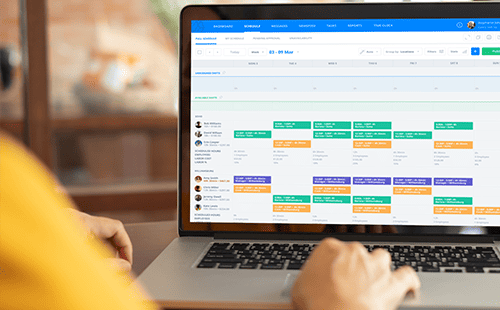
Whether your business uses a DuPont shift schedule, a 2-2-3 work schedule, a hybrid work schedule, or even a more traditional “9-to-5” fixed schedule, Sling can help you save time, improve efficiency, and communicate better with your team.
The Sling app comes with a long list of features, including:
These features can help you organize and optimize your team’s activities within any and every work schedule possible.
To find out more about how our powerful scheduling, timekeeping, and task management features can transform your organization, your workflow, and your team dynamic, visit GetSling.com today.
This content is for informational purposes and is not intended as legal, tax, HR, or any other professional advice. Please contact an attorney or other professional for specific advice.
See Here For Last Updated Dates: Link
No, the schedule only affects when your employees work. It doesn’t affect their status (i.e., full-time vs. part-time), nor does it affect the level at which you pay out any agreed-upon benefits.
That said, the schedule does average out to them working about 42 hours per week over the 28-day cycle. That means that most employees will consistently earn two hours of built-in overtime every week. The key is to factor that extra pay into your yearly budget.
Since the DuPont schedule is built for 24/7 businesses, the rotation usually stays the same even on holidays. Most managers handle this by offering holiday premium pay (e.g., time-and-a-half) for the team whose turn it is to work that day.
This keeps the rotation fair without having to manually rebuild the calendar every time a holiday pops up.
Shift Work Sleep Disorder (SWSD) is a condition that can affect people who frequently change from working days to working nights. SWSD makes them feel extra tired and reduces their ability to focus on the task at hand.
To help your team stay healthy, experts suggest using a forward-rotating schedule where employees move from the day shift to the night shift.
This type of schedule is typically better for your employees both physically and mentally because it’s easier to stay up later than to go to sleep earlier.
Of course, this isn’t always possible because, at some point in the DuPont schedule, they’ll have to move from night shift to day shift. But you can help your team deal with this by encouraging strict sleep hygiene, strategic light management, and consistent routines.
Technically, yes, you only need four people to make the DuPont schedule work, but it can be risky. If one person gets sick or takes a vacation, you have no one to cover them without making someone else work a 24-hour shift.
Most businesses find it works best with at least eight to 12 employees (i.e., two or three per team) so that there is at least one backup for every position.

Schedule faster, communicate better, get things done.